After 50, many patients are not trying to look 25. They want their skin to look smoother, healthier, brighter, and more rested while still looking like themselves.
The challenge is that “skin texture” can describe several different changes at once: roughness, enlarged-looking pores, fine lines, crepey skin, sun damage, acne scars, or mild laxity. RF microneedling and laser resurfacing can both support skin renewal, but they work differently and are not interchangeable.
The best result starts by identifying which layer is creating the concern.
Quick Answer: What Is the Best Way to Improve Skin Texture After 50?
For mature skin, RF microneedling is often considered when the priorities are dermal remodeling, mild laxity, fine lines, or texture with less surface disruption. Laser resurfacing is often considered when the priorities are sun damage, etched lines, rough surface texture, or more visible resurfacing.
Neither treatment is automatically better. A natural-looking plan may use one treatment, a staged combination, or another option entirely when volume loss, muscle movement, or significant tissue descent is the real issue.
Why Skin Texture Changes After 50
Skin aging is not a single process. By the 50s and beyond, several changes may overlap:
- Collagen and elastin production slows
- The skin may become thinner and drier
- Decades of ultraviolet exposure become more visible
- Cell turnover may slow
- Fine lines can become more etched
- Pores and surface irregularities may look more noticeable
- Facial volume and bone support change
- Skin may not recover from inflammation as quickly
- Hormonal changes can affect hydration and skin quality
This is why one person may need resurfacing for sun-damaged texture while another needs support for laxity or volume loss. Choosing treatment by age alone is less useful than treating the specific concern.
What Does RF Microneedling Do?
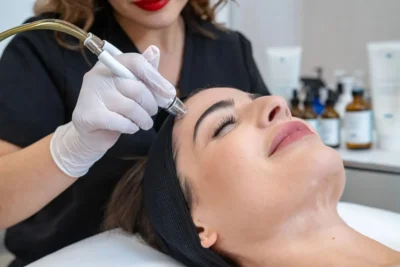
RF microneedling places small needles into the skin and delivers controlled radiofrequency energy at selected depths. Touch & Glow offers Vivace Ultra RF microneedling.
The treatment is designed to create controlled dermal heating and a wound-healing response while leaving more of the skin surface intact than an ablative laser.
RF microneedling may be considered for:
- Mild skin laxity
- Fine lines
- Enlarged-looking pores
- Uneven texture
- Selected acne scars
- Crepey skin
- Neck or lower-face skin quality
- Patients seeking less surface downtime
Results depend on device settings, needle depth, treatment area, tissue thickness, and the number of sessions. RF microneedling is a medical procedure and should be performed by a licensed provider with specific training and experience.
What Does Laser Resurfacing Do?
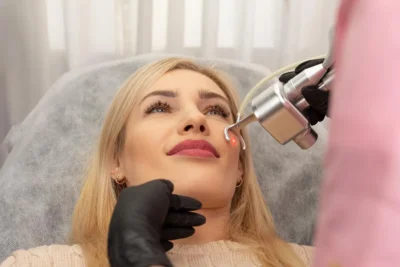
Laser resurfacing uses light energy to remove or heat controlled areas of skin. Different lasers behave differently, so “laser resurfacing” is not one treatment.
Touch & Glow offers CO2 and Erbium YAG resurfacing.
CO2 laser is generally selected when stronger resurfacing and thermal collagen remodeling are priorities. Erbium YAG is highly absorbed by water and allows precise tissue ablation with less residual heat than CO2.
Laser resurfacing may be considered for:
- Rough surface texture
- Fine lines and deeper wrinkles
- Sun spots and photoaging
- Acne scars
- Uneven skin quality
- Enlarged-looking pores
- More visible surface renewal
A more aggressive laser treatment usually brings more visible recovery. The laser, treatment depth, skin tone, treatment area, and recent sun exposure all affect candidacy.
RF Microneedling vs. Laser Resurfacing at a Glance
When Surface Damage Is the Main Concern
Laser resurfacing often has the advantage for etched lines, roughness, and accumulated sun damage because it directly renews the skin surface.
When Mild Laxity Is the Main Concern
RF microneedling may be useful when the priority is controlled dermal remodeling and mild tightening without ablating the entire surface.
When Downtime Is Limited
RF microneedling generally involves less visible surface recovery. Laser downtime varies substantially; deeper CO2 treatment usually requires more healing than a lighter Erbium treatment.
When Pigment Risk Matters
Either treatment can cause pigment changes. RF microneedling may be considered across a broader range of skin tones because less epidermal tissue is disrupted, but it is not risk-free. Laser candidacy and settings require particular care when there is more melanin, recent tanning, or a history of post-inflammatory hyperpigmentation.
When a Stronger Single Treatment Is Desired
A more intensive laser resurfacing session may create greater surface change in one treatment, but it also requires a larger recovery commitment. RF microneedling is commonly approached as a series.
Which Treatment Is Better for Rough or Uneven Texture?
If texture changes are concentrated at the surface, such as roughness, fine etched lines, or visible photoaging, laser resurfacing may provide the more direct correction.
If texture is connected to pores, mild scarring, or loss of firmness beneath the surface, RF microneedling may be a reasonable option.
Many patients have both surface and deeper changes. A provider may recommend treating the most important concern first and reassessing after healing rather than doing everything at once.
Which Treatment Is Better for Crepey Skin After 50?
Crepey skin can result from thinning, dryness, sun damage, collagen loss, and laxity. The location matters.
Erbium or CO2 resurfacing may improve fine surface lines and roughness. RF microneedling may support dermal remodeling and mild firmness. Very thin areas, including around the eyes, require conservative settings and specialized experience.
Neither technology can replace surgery when a significant amount of loose skin is present.
Which Treatment Is Better for Sun Damage?
Laser resurfacing may have an advantage when sun-related surface texture and lines are prominent. Some brown spots may improve as damaged skin renews.
However, not all discoloration is the same. Melasma, post-inflammatory hyperpigmentation, redness, isolated sun spots, and suspicious lesions require different evaluation. Aggressive heat or inflammation can worsen certain pigment conditions.
Arizona patients must be especially realistic about sun avoidance before and after treatment. For some people, scheduling a more intensive procedure during a cooler season makes recovery easier, but lifestyle and compliance matter more than the calendar alone.
Which Treatment Is Better for Fine Lines and Wrinkles?
CO2 or Erbium resurfacing may be stronger for lines etched into the skin surface. RF microneedling can support collagen remodeling and may improve finer lines with a different recovery profile.
Expression lines caused by repeated muscle movement may respond better to a neuromodulator. Deep folds related to volume loss or tissue descent will not disappear simply because the surface is smoother.
Treating the cause helps the result look more natural.
How Can I Look Refreshed Without Looking Overdone?
Natural-looking rejuvenation usually comes from restraint, diagnosis, and sequencing, not from choosing the weakest treatment.
A thoughtful plan may include:
- Improving skin quality before adding volume
- Treating one or two priority concerns instead of chasing every line
- Using conservative, customized energy settings
- Preserving normal facial movement and expression
- Avoiding filler where heaviness or tissue descent is the main issue
- Allowing collagen remodeling to develop before adding another procedure
- Taking standardized photographs and reassessing objectively
- Supporting results with sunscreen and a tolerable home routine
The goal is not a perfectly smooth or motionless face. It is healthier-looking skin and better balance while preserving the features that make you recognizable.
When Skin Treatments Are Not Enough
RF microneedling and laser resurfacing improve skin quality. They do not replace every kind of facial rejuvenation.
If the concern is primarily:
- Dynamic lines, a neuromodulator may be more relevant
- Volume loss, carefully selected filler or a biostimulatory treatment may be considered
- Lower-face tissue descent, PDO threads or surgical consultation may be more appropriate
- Significant eyelid or facial skin excess, surgery may create a more meaningful correction
- Active skin disease or a suspicious lesion, medical evaluation comes first
Sometimes the least overdone result comes from not asking one procedure to solve a problem outside its strengths.
Can RF Microneedling and Laser Resurfacing Be Combined?
They may be used in a staged plan when the patient has both surface and deeper concerns. That does not mean both treatments should automatically be performed together.
A provider may begin with the dominant concern, allow complete healing, and then decide whether a second modality would add enough value to justify the cost and recovery.
Treatment sequence should account for skin tone, tissue thickness, history of scarring or pigment change, medical history, and the intensity of each session.
What Does Recovery Look Like?
After RF microneedling, temporary redness, swelling, tenderness, pinpoint marks, or a rough texture can occur. Recovery varies with treatment depth and energy.
After ablative laser resurfacing, visible effects may include redness, swelling, sensitivity, peeling, crusting, dryness, and lingering pinkness. Deeper CO2 treatment generally requires more recovery than lighter resurfacing.
Patients should receive specific instructions for cleansing, moisturizers, skincare ingredients, makeup, exercise, heat, and sun protection. Picking, scrubbing, or rushing the healing process can increase risk.
Safety Considerations for RF Microneedling
The FDA has warned that serious complications have been reported with certain uses of RF microneedling devices, including burns, scarring, fat loss, disfigurement, and nerve damage.
Patients should ask which device will be used, why the proposed settings fit the treatment area, and what training the provider has with the device. RF microneedling should not be treated as an at-home beauty service.
Potential benefits must be weighed against risks, particularly in thin facial areas or when aggressive depths and energy are proposed.
Who Is a Good Candidate After 50?
Age alone does not determine candidacy. A healthy patient in their 60s may heal more predictably than a younger patient with active skin disease, recent tanning, or a history of poor wound healing.
A consultation should review:
- The exact concern and treatment area
- Skin tone and pigment history
- Sun exposure and upcoming travel
- Previous lasers, threads, fillers, or surgery
- Medications and supplements
- History of cold sores
- Active infection or inflammatory skin disease
- Bleeding or healing concerns
- Whether the patient can follow recovery instructions
- Expectations for subtle versus dramatic change
How Many Treatments Will I Need?
RF microneedling is often planned as a series, with results developing gradually. Laser plans range from lighter sessions to a more intensive single treatment.
The correct number depends on the baseline concern, selected device, settings, healing response, and desired result. A package should not replace an individualized plan.
Frequently Asked Questions
Is RF microneedling or laser better for mature skin?
Neither is universally better. RF microneedling may fit mild laxity and dermal texture, while laser resurfacing may fit etched lines, roughness, and sun damage.
Can I improve skin texture after 50 without filler?
Yes. RF microneedling, laser resurfacing, skincare, and other treatments can improve skin quality without adding volume. Whether filler is useful depends on facial structure and the specific concern.
Will laser resurfacing make me look unnatural?
Laser does not add volume or freeze movement. When appropriately selected, its goal is to improve skin quality. An unnatural result is more likely when treatment is too aggressive, poorly matched, or combined without a clear plan.
Does RF microneedling cause facial fat loss?
The FDA has received reports of fat loss and other serious complications with certain uses. Risk depends on the device, depth, energy, treatment area, and technique. Discuss the proposed protocol with a trained licensed provider.
Which treatment has less downtime?
RF microneedling generally has less surface downtime. Laser recovery varies; deeper CO2 treatment typically requires more visible healing than lighter Erbium resurfacing.
Can I combine laser with Botox or filler?
Sometimes, but timing matters. Your provider should plan the sequence based on healing, treatment area, and the reason for each procedure.
What is the most natural-looking treatment after 50?
The most natural plan treats the dominant cause, whether texture, pigment, movement, volume, or laxity, with the least amount of intervention needed to meet the goal.
Is one treatment enough?
One intensive laser session may create meaningful change for some patients. RF microneedling is commonly performed as a series. Results and maintenance vary.
Ready for a Personalized Skin Plan?
You do not need to choose a device before your consultation.
At Touch & Glow Med Spa in Glendale, Arizona, the first step is identifying whether your main concern comes from the skin surface, deeper collagen, pigment, volume, muscle movement, or tissue laxity. From there, your provider can discuss RF microneedling, CO2 laser, Erbium YAG, injectables, skincare, or a staged plan designed to help you look refreshed without looking overdone.
Results vary. Treatment recommendations require an individual consultation.