Reviewed by Wendy Beltran, FNP-BC, co-founder and lead provider at Touch and Glow Med Spa, Glendale, AZ. Last updated July 2026.
Quick answer: CO2 laser resurfacing (10,600 nm) works deeper and delivers the most dramatic correction of deep lines, acne scars, and heavy sun damage, usually in a single treatment, with roughly 7 to 14 days of visible healing. Erbium YAG laser resurfacing (2,940 nm) removes tissue more precisely with far less residual heat, so most people are socially presentable in about 3 to 5 days, and it is typically done as a series of 1 to 3 sessions. Neither laser is a fixed setting. Both are fully adjustable, so the real question is not “which laser is stronger,” it is “which depth and downtime match your skin and your calendar.”
If you have been researching laser skin resurfacing in Glendale, AZ, you have probably run into these two names over and over and come away more confused than when you started. One forum says CO2 is the gold standard. The next says Erbium is safer. Somewhere in there, someone posted a terrifying day-three photo and now you are convinced laser resurfacing means a week of hiding in a dark room with a blistered face.
Let’s clear all of that up.
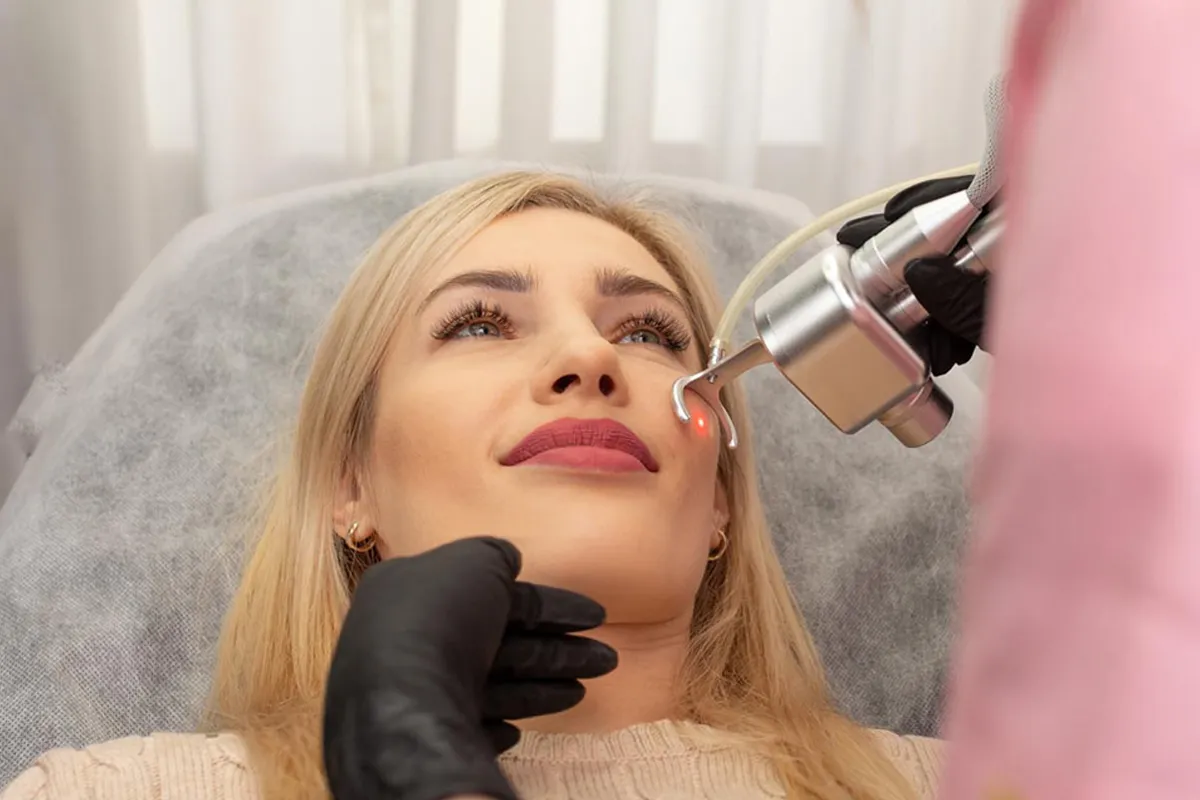
Touch and Glow Med Spa now offers both CO2 and Erbium YAG laser rejuvenation at our Glendale location, along with Vascular YAG for redness and broken capillaries. Below is the honest, side by side breakdown we give patients in consultation: how each laser works, what each one is genuinely good at, exactly how much social downtime to plan for, and why “aggressive” is a dial we set, not a personality trait of the machine.
CO2 vs. Erbium YAG at a Glance
| CO2 Laser | Erbium YAG Laser | |
|---|---|---|
| Wavelength | 10,600 nm | 2,940 nm |
| Absorbed by | Water in the skin | Water in the skin (roughly 10x more efficiently) |
| Residual heat left behind | Approximately 100 to 150 microns | Approximately 5 to 20 microns (adjustable up to about 50) |
| Best for | Deep lines, acne scarring, advanced sun damage, laxity | Fine lines, texture, tone, dullness, thin-skinned areas |
| Typical sessions | 1 | 1 to 3 |
| Social downtime | About 7 to 14 days | About 3 to 5 days |
| Skin tightening effect | Strong (heat drives collagen contraction) | Mild to moderate (depends on pulse settings) |
| Risk profile on darker skin tones | Higher, requires careful settings and prep | Lower, generally more forgiving |
| Best areas | Face, and hands with conservative settings | Face, under eyes, neck, chest, hands |
| Touch and Glow intro pricing | From $1,499 (regular $2,000) | From $299 by zone, full face from $799 |
What Both Lasers Are Actually Doing
Both CO2 and Erbium YAG are ablative lasers. That means they remove tissue rather than just heating it from underneath.
Here is the mechanism in plain English. Your skin is mostly water. Both of these lasers are tuned to a wavelength that water absorbs greedily. When the beam hits the skin, the water in those cells absorbs the energy, flashes to vapor, and takes the damaged tissue with it. Underneath, your body reads that as an injury and starts a repair response: new collagen, new elastin, fresh epidermis.
That repair response is the entire point. You are not “burning off” your skin. You are triggering a rebuild.
Both lasers can be run in fractional mode, which is what we use for most patients. Instead of removing one continuous sheet of tissue, the beam is split into a grid of microscopic treatment columns, leaving healthy untreated skin in between. That untreated skin acts as a healing reservoir and pulls the whole area back together far faster. Fractional delivery is the single biggest reason modern resurfacing looks nothing like the two-week-raw-face horror stories from the 1990s.
The difference between the two lasers comes down to one thing: how much heat gets left behind.
How CO2 Laser Resurfacing Works
CO2 lasers operate at 10,600 nm. Water absorbs this wavelength well, but not perfectly. Some of that energy spreads sideways as heat into the tissue surrounding each treatment column.
That leftover heat, roughly 100 to 150 microns of it, is not a flaw. It is a feature, and it is the whole reason CO2 has been the reference standard for aggressive resurfacing for thirty years:
- Collagen contraction. Heat causes collagen fibers to shrink and tighten immediately, then reorganize over the following months. This is why CO2 gives a tightening effect that lighter treatments simply cannot match.
- Deeper remodeling. The thermal zone extends the biological signal further into the dermis, driving a stronger long-term rebuild.
- Hemostasis. The heat seals small vessels as it goes, which keeps the treatment cleaner.
The tradeoff is the honest part: more heat means a longer repair. Deep CO2 resurfacing has historically required somewhere in the range of 10 to 14 days to fully re-epithelialize, with pinkness that can linger for weeks after that. Modern fractional delivery has compressed that meaningfully, but CO2 is still the option you plan your calendar around, not the one you squeeze in on a Thursday.
The CO2 sweet spot: the lines Botox cannot reach. Botox relaxes muscles, so it works beautifully on dynamic lines. But etched-in static lines, the ones that stare back at you when your face is completely still, are structural. That is a resurfacing problem, not a neurotoxin problem.
How Erbium YAG Laser Resurfacing Works
Erbium YAG operates at 2,940 nm, which sits almost exactly on the peak of water’s absorption curve. Water absorbs Erbium roughly ten times more efficiently than it absorbs CO2.
That efficiency changes everything. Because the energy is consumed so completely at the surface, almost none of it has a chance to spread sideways. Erbium ablates in clean, precise micro-columns and leaves only about 5 to 20 microns of residual heat behind. Clinicians sometimes call this “cold ablation.”
What that buys you:
- Faster healing. Less collateral heat means less tissue to repair, which means a shorter, easier recovery.
- Shorter redness. Prolonged post-treatment erythema is largely a thermal phenomenon. Less heat, less lingering pink.
- Lower pigment risk. Heat is a major trigger for post-inflammatory hyperpigmentation. This is why Erbium is generally the more forgiving option for medium and deeper skin tones, which matters a great deal in a Phoenix metro population.
- Precision on thin skin. Micron-level control is exactly what you want on eyelids, neck, and chest.
The tradeoff: less heat means less collagen contraction, so a single Erbium pass will not tighten the way CO2 does. That is why Erbium is usually planned as a series of 1 to 3 treatments spaced several weeks apart. You build the result instead of front-loading it.
Modern Erbium platforms also offer long-pulse and dual modes, which deliberately extend the pulse to add a controlled coagulation zone (up to roughly 50 microns). In practice, that means we can dial an Erbium treatment closer to CO2 behavior when a patient needs a bit more, without committing to full CO2 recovery.
Use Cases: When We Recommend CO2
CO2 is usually the right call when the concern is structural, deep, or long-standing:
- Deep static wrinkles, especially around the mouth (perioral or “lipstick” lines) and the smile lines that persist at rest
- Atrophic acne scarring, including boxcar and rolling scars
- Surgical and traumatic scars that need real remodeling, not just softening
- Advanced photoaging. Twenty Arizona summers do measurable structural damage. Leathery texture, mottled tone, and crepiness on the same face is a CO2 conversation.
- Perioral and periorbital crepiness where the skin has lost its snap
- Patients who want one and done. If you are willing to trade a week of your life for the biggest single-session change available, CO2 is that trade.
- Enlarged pores and rough texture that have not responded to microneedling or peels
If you have already tried Vivace RF microneedling, SkinPen, or medical-grade chemical peels and liked the results but wanted more, CO2 is the natural next step up.
Use Cases: When We Recommend Erbium YAG
Erbium is usually the right call when the concern is surface-level, or when the anatomy demands precision:
- Fine lines and early etching, before they become deep folds
- Texture, dullness, and tone. The classic “my skin looks tired and I cannot fix it with products” complaint.
- Sun spots and uneven pigment from Arizona living, particularly for patients also managing hyperpigmentation
- Under-eye crepiness. Eyelid skin is the thinnest on the body. Precision is not optional there.
- Neck and chest. More on why below.
- Medium to deeper skin tones. Lower thermal load means a meaningfully lower pigment risk.
- Patients who cannot disappear for two weeks. Teachers, realtors, nurses, anyone client-facing.
- Patients who are honestly just nervous about CO2. This is a completely legitimate reason, and it is one of the most common reasons we start people on Erbium. Some patients do a round of Erbium, love it, and graduate to CO2 later. Others never need to.
- Maintenance. Erbium is an excellent annual tune-up after a CO2 result to protect your investment.
Social Downtime: The Real Difference
This is the question everyone actually cares about, so let’s separate two things people constantly confuse.
Medical downtime is how long until your skin is biologically healed. Social downtime is how long until you can walk into Costco without anyone looking twice.
Social downtime is shorter. It is also the number that matters for your calendar.
CO2 Laser: What the Week Looks Like
| Timeframe | What to expect |
|---|---|
| Day 0 | Warmth and a strong sunburn sensation. Redness and tightness set in. |
| Days 1 to 3 | Peak swelling, deep redness, and a bronzed look. Skin feels rough and tight. Plan to be home. |
| Days 3 to 6 | Bronzing peaks and micro-flaking begins. This is the ablated tissue sloughing on schedule. Do not pick it. |
| Days 5 to 8 | Most flaking is finished. Fresh pink skin underneath. |
| Days 7 to 10 | Most patients are cleared for mineral makeup and comfortable in public. |
| Weeks 2 to 8 | Residual pinkness fades gradually. Makeup covers it easily. |
| Months 3 to 6 | Collagen remodeling continues. Your final result keeps improving long after you look “normal.” |
Plan for 7 to 14 days of social downtime. Most patients schedule CO2 around a long weekend, a vacation, or a work-from-home stretch. If you have a wedding, do it at least eight weeks out, not two.
Erbium YAG: What the Week Looks Like
| Timeframe | What to expect |
|---|---|
| Day 0 | Looks and feels like a moderate sunburn. Warm, pink, mild tightness. |
| Days 1 to 2 | Redness and light swelling. Many patients are already comfortable running errands. |
| Days 2 to 4 | Fine, sandpapery flaking. Think dry sunburn peel, not sheets. |
| Days 3 to 5 | Most patients are back to makeup and normal life. |
| Weeks 2 to 6 | Glow and clarity build. Additional sessions stack the result. |
Plan for 3 to 5 days of social downtime. Treat on a Thursday, be reasonable by Monday. That is the whole appeal.
One caveat we tell every patient: these ranges assume typical settings. Downtime scales with depth and density. A conservative Erbium pass might have you out in two days. A deep, dense Erbium pass on the whole face can push toward CO2 territory. Your consultation is where we set that expectation precisely, not the internet.
Will Laser Resurfacing Blister or Burn My Face?
Let’s address this head-on, because it is the number one fear we hear and the internet has done a spectacular job of making it worse.
Properly performed laser resurfacing does not blister your skin.
Blistering is not a normal, expected, “part of the process” outcome. Blistering is a sign of over-treatment, wrong settings for that skin type, treating skin that should not have been treated (an active tan, an unmanaged condition), or aftercare that went sideways. It is a complication, not a milestone.
Here is what a correctly performed treatment actually looks and feels like:
What you should expect:
- A hot, prickly sunburn sensation during and right after (we numb thoroughly first, and use cooling throughout)
- Redness, warmth, and mild to moderate swelling
- A tight, “my face is too small for my face” feeling for a day or two
- A fine sandpaper texture as micro-columns heal
- Flaking and shedding on a predictable schedule
- With deeper CO2, some pinpoint bleeding or light weeping in the first 24 to 48 hours, which is expected and is a completely different thing from a blister
What you should not expect:
- Open blisters
- Skin that looks burned or charred
- A raw, weeping face for a week
- Anything that makes you think “something went wrong”
The reason we can promise that is not marketing. It is physics and protocol:
- Fractional delivery. We leave healthy skin between every treatment column. Those bridges of intact tissue are what make the whole thing heal fast and predictably.
- Settings are chosen for you, not for the brochure. Depth, density, and pulse duration are set based on your skin type, your area, and your tolerance.
- We start conservative. Test spots and a conservative first pass are standard, especially on new patients, thin skin, and medium to deeper Fitzpatrick types.
- Consult first, always. Both CO2 and Erbium require a consultation at Touch and Glow. No exceptions. That is not a sales step, it is the safety step.
- Prep and aftercare matter as much as the laser. Pigment protocols, sun avoidance, antiviral prophylaxis where indicated, and a proper post-care kit are what keep results clean.
“Aggressive” is a number we type into a machine. It is not something the laser does on its own.
Adjustable Treatment Modes: This Is Not a One-Setting Machine
The single most useful thing to understand about modern resurfacing is that both platforms are highly tunable. Same laser, same patient, wildly different treatment depending on what we ask it to do.
Here is what we adjust:
Depth (energy / fluence). How far each micro-column travels into the skin. This is the primary dial for “how strong.”
Density (coverage). What percentage of the treated area actually gets ablated. Low density means more healthy skin left between columns, which means faster healing. High density means more correction and a longer recovery. Depth and density are independent, which is why we can go deep and sparse, or shallow and dense, depending on the goal.
Pulse duration. On Erbium especially, this is the magic dial. A very short pulse gives clean cold ablation with almost no heat. A longer pulse deliberately leaves a coagulation zone behind, adding tightening and hemostasis. Dual mode blends both in a single pass.
Fractional versus full field. Fractional for most patients. Full-field peel mode for select superficial work.
Number of passes. Layering passes builds depth incrementally, with the operator reading the tissue in real time between each one.
Mode selection. Most platforms offer distinct programs: a light “peel” or refresh mode, a mid-range rejuvenation mode, and a deep resurfacing mode.
What that means for you in practice: your treatment can be dialed up for a deep scar on the cheek and dialed down for the delicate skin under your eye in the same session. That is not a compromise. That is the correct way to treat a face.
It also means the honest answer to “how much downtime will I have” is always “let’s look at your skin first.” Anyone who quotes you a number before seeing your face is guessing.
Treatment Areas: Face, Neck, Chest, and Hands
Your face is not the only thing that gives away your age, and in Arizona it is often not even the first thing.
Face
Both lasers treat the full face, and this is where the widest range of settings applies. We commonly treat around the mouth, around the eyes, cheeks, forehead, and the full face as a unit. Zones can be treated at different intensities in one visit.
Under Eyes
Eyelid skin is the thinnest on the body, and it shows crepiness before anywhere else. Erbium’s precision makes it our preferred tool here. Under-eye Erbium is one of our most requested individual zones and is priced separately for exactly that reason.
Neck
The neck is where inexperienced resurfacing goes wrong, and here is the anatomical reason: your face is dense with hair follicles and oil glands, and those structures are what your skin uses to regenerate its surface after ablation. Your neck has far fewer of them. Less regenerative machinery means slower healing and a genuinely higher scarring risk if the settings are too aggressive.
This is the clearest case in all of resurfacing where less heat wins. Erbium’s minimal thermal footprint is a real safety advantage on the neck, which is why we price and promote Erbium neck treatment as a dedicated service.
Chest and Decolletage
Same anatomical story as the neck, plus the highest cumulative sun exposure of any area outside the face. If you have driven around the Valley for twenty years with the sun coming through the windshield, your chest knows. The classic V-shaped sun damage pattern with mottled brown pigment, red capillaries, and crepey texture responds well to conservative Erbium.
An important note on the chest: pigment and vessels are two different problems. If redness and broken capillaries are the dominant concern rather than texture, Vascular YAG is the better tool. Many patients get their best chest result from a combination.
Hands
Hands are absolutely treatable and are one of the most under-treated areas in aesthetics. They are also thin, low in adnexal structures, and slower to heal than the face.
Can CO2 be used on hands? Yes, at conservative fractional settings, and the results on sun spots and crepey texture can be excellent. But this is a consultation-dependent area where we set expectations carefully. Aggressive settings on the dorsal hand are how people get into trouble. If your primary hand concern is pigment rather than texture, IPL photofacial or Erbium may get you there with less recovery.
Treating Areas Together
Faces do not exist in isolation, and a beautifully resurfaced face above an untreated neck creates a line of demarcation that everyone notices. When we treat the face, we usually recommend carrying the treatment into the neck and chest at appropriately reduced settings so everything reads as one continuous, even result.
Which Laser Is Right for You? A Quick Self-Check
You are probably a CO2 candidate if:
- Your lines are still there when your face is completely relaxed
- You have acne scarring with real depth to it
- You want the single biggest change available in one session
- You can block off a week to ten days
- You have tried lighter treatments and want more
You are probably an Erbium candidate if:
- Your concerns are texture, tone, dullness, and fine lines
- The under eyes, neck, or chest are your priority
- You have a medium to deeper skin tone
- You cannot disappear for two weeks
- You want to start conservatively and build
- CO2 makes you nervous, and you would rather ease in
Still not sure? That is the entire purpose of the consultation, and it is required for both treatments anyway.
Can You Combine CO2 and Erbium YAG?
Yes, and thoughtful combinations are often where the best results come from.
- Zone-based combining. Deeper settings on scarred or heavily lined areas, lighter settings on delicate areas, all in one session.
- Sequencing. Some patients do CO2 for the heavy lifting, then annual Erbium sessions to maintain the result.
- Layering with other modalities. Resurfacing fixes surface and texture. It does not replace volume. Many patients pair a resurfacing plan with dermal fillers, PDO threads, Botox, or PRF for a complete plan.
- Adding Vascular YAG. Redness, spider veins, cherry angiomas, and broken capillaries are a vascular problem, not a texture problem. Different tool, often the same treatment plan.
CO2 and Erbium YAG Laser Pricing in Glendale, AZ
Current introductory pricing at Touch and Glow Med Spa, Glendale:
| Treatment | Intro Price | Regular Price |
|---|---|---|
| CO2 Laser Facial Rejuvenation (single treatment) | $1,499 | $2,000 |
| Erbium YAG, Full Face | $799 | $1,000 |
| Erbium YAG, Neck | $799 | $1,000 |
| Erbium YAG, Lower Face | $299 | $500 |
| Erbium YAG, Under Eyes | $499 | $600 |
| Vascular Reduction (Long-Pulsed YAG) | From $225 | Varies by area |
All laser treatments require a consultation. Pricing is current as of July 2026 and is subject to change. Payment plans through PatientFi and Cherry are available, and T&G VIP App members receive additional savings.
Laser Launch Party: Saturday, August 1, 2026
We are formally launching our laser program with an open house at our Glendale location, and it is the single best time to get your questions answered without committing to anything.
Saturday, August 1, 2026 | 10:00 AM to 1:00 PM Touch and Glow Med Spa 5620 W. Thunderbird Rd, Suite D-3, Glendale, AZ 85306
What is happening:
- Complimentary one-on-one laser consultations with our laser specialist
- Live demos of CO2, Erbium YAG, and Vascular YAG
- Up to 50% off laser packages, event day only
- Complimentary Chickies Coffee Cart drinks
- Goodie bags, raffle prizes, and event-only giveaways
- Educational booths and a first look at what is new
RSVP by July 25, 2026: call or text (602) 562-9800. Walk-ins are welcome, but RSVPs get priority. Come makeup-free if you want a live demo or skin analysis. Full event details here.
Why Touch and Glow Med Spa for Laser Resurfacing
Resurfacing results depend more on the person running the laser than on the laser itself. That is not a slogan, it is the consensus of every dermatologic society that has ever weighed in on the subject.
- Family-owned since 2018. Founded by Wendy and Leo Beltran, a husband-and-wife team with over a decade of medical experience.
- Wendy Beltran, FNP-BC, co-founder and lead provider, with expertise spanning injectables, biostimulators, RF microneedling, and cosmetic laser treatments.
- 400+ five-star Google reviews and recognized as Best Med Spa in Glendale, AZ.
- Consult-first, never pushy. Every laser patient gets a real evaluation, an honest downtime conversation, and a plan built around their skin. If a laser is not right for you, we will tell you.
- Two Valley locations, Glendale and Peoria, serving Phoenix, Peoria, Surprise, Sun City, Scottsdale, and the greater West Valley.
See our patient gallery or read our reviews.
Frequently Asked Questions
What is the main difference between CO2 and Erbium YAG lasers?
CO2 lasers operate at 10,600 nm and leave roughly 100 to 150 microns of residual heat in the skin, which drives stronger collagen tightening but requires 7 to 14 days of recovery. Erbium YAG operates at 2,940 nm and is absorbed by water about ten times more efficiently, so it ablates precisely and leaves only 5 to 20 microns of heat behind, producing 3 to 5 days of typical downtime with less pigment risk.
Which laser is better, CO2 or Erbium YAG?
Neither is universally better. CO2 is better for deep wrinkles, acne scars, and advanced sun damage when you can afford the downtime. Erbium YAG is better for fine lines, texture, tone, thin-skinned areas like the under eyes and neck, medium to deeper skin tones, and anyone who needs to be back in public within a few days.
How long is the downtime for CO2 laser resurfacing?
Plan for about 7 to 14 days of social downtime. Peak swelling and redness are days 1 to 3, flaking runs roughly days 3 to 8, and most patients are comfortable in mineral makeup around day 7 to 10. Residual pinkness can linger for several weeks and is easily covered.
How long is the downtime for Erbium YAG laser resurfacing?
Most patients plan for 3 to 5 days. Day 0 looks like a moderate sunburn, fine flaking runs days 2 to 4, and most people are back to makeup and normal activity by day 3 to 5.
Does laser resurfacing blister your skin?
No. Properly performed fractional resurfacing does not blister. Expect redness, warmth, swelling, tightness, and fine flaking on a predictable schedule. Blistering is a sign of over-treatment or an aftercare problem, not a normal part of healing, which is why settings, provider training, and a real consultation matter.
Can laser settings be adjusted for sensitive skin or delicate areas?
Yes. Depth, density, pulse duration, number of passes, and fractional versus full-field delivery are all independently adjustable. That means we can treat a deep line on the cheek and delicate under-eye skin at completely different intensities in the same session.
Can you do laser resurfacing on the neck and chest?
Yes, with the right laser and conservative settings. The neck and chest have far fewer hair follicles and oil glands than the face, and those structures are what the skin uses to regenerate after ablation. Fewer of them means slower healing and higher scarring risk if the treatment is too aggressive. Erbium YAG’s minimal thermal footprint makes it the safer choice for these areas.
Can CO2 laser be used on hands?
Yes, at conservative fractional settings, and results on sun spots and crepey texture can be excellent. Hands are thin and slower to heal than the face, so this is a consultation-dependent area. If pigment rather than texture is the main concern, IPL or Erbium may be a better fit.
How many treatments will I need?
CO2 is typically positioned as a single treatment. Erbium YAG is usually a series of 1 to 3 sessions spaced several weeks apart, depending on your goals and starting point.
Is laser resurfacing safe for darker skin tones?
Erbium YAG is generally the more forgiving option for medium and deeper skin tones because it leaves far less heat in the skin, and heat is a primary trigger for post-inflammatory hyperpigmentation. CO2 can be performed on darker skin, but requires careful settings, a proper pre-treatment pigment protocol, and an experienced provider. A consultation is required either way.
Does laser resurfacing hurt?
We numb thoroughly before treatment and use cooling throughout. Most patients describe the sensation as hot and prickly, similar to a strong sunburn, rather than sharp pain. Erbium is generally more comfortable than CO2.
When will I see results?
Surface improvements in tone and texture show up as soon as the flaking finishes. The collagen-driven results build over the following 3 to 6 months, so your skin keeps improving long after you look normal again.
How much does laser resurfacing cost in Glendale, AZ?
At Touch and Glow Med Spa, CO2 Laser Facial Rejuvenation starts at $1,499 (regular $2,000). Erbium YAG is priced by zone, starting at $299 for lower face, $499 for under eyes, and $799 for full face or neck. All laser treatments require a consultation, and financing is available.
What is the best time of year for laser resurfacing in Arizona?
Fall and winter are ideal. Post-resurfacing skin is highly photosensitive, and strict sun avoidance is required during healing. If you treat in summer, you need a realistic plan for staying out of the sun, which in the Valley means genuinely staying out of it.
Book Your Laser Consultation in Glendale, AZ
The right laser for you is the one that matches your skin, your goals, and the number of days you can realistically give it. Nobody can tell you which one that is from a blog post, including this one. That is what the consultation is for, and it is required before any laser treatment at Touch and Glow.
Ready to find out which laser fits your skin?
Book your laser consultation online or call (602) 562-9800.
Touch and Glow Med Spa Where You Love to Glow
Glendale: 5620 W. Thunderbird Road, Suite D-3, Glendale, AZ 85306 Peoria: 25546 N. Lake Pleasant Pkwy #1350, Suite #7, Peoria, AZ 85383 Phone: (602) 562-9800 | Email: info@touchandglowskincare.com
Serving Glendale, Peoria, Phoenix, Surprise, Sun City, Scottsdale, and the greater West Valley.
This article is for educational purposes and is not medical advice. Individual results vary. Candidacy, settings, treatment count, and downtime are determined during an in-person consultation with a licensed provider. Laser resurfacing carries risks including redness, swelling, pigment changes, infection, and scarring. Discuss your full medical history with your provider.
Wendy Beltran, FNP-BC, is the Medical Director and lead injector at Touch and Glow Med Spa in Glendale, Arizona. A Family Nurse Practitioner since 2008 with a clinical background in Gastroenterology, Family Practice, and Urgent Care, Wendy combines deep medical expertise with an artistic eye to deliver natural-looking results. She has been an aesthetic injector since 2018 and is passionate about patient education and safety.